Few household noises are quite as alarming as a central heating system that suddenly sounds like an industrial steam train or a giant kitchen kettle reaching a violent, thrashing boil. This distinct phenomenon—known across the plumbing industry as “kettling”—presents itself as a combination of loud whistling, deep rhythmic thumping, and sharp metallic popping sounds inside the boiler casing.
When investigating what causes a boiler kettling sound and how to fix it, you are looking at a system experiencing severe internal thermal stress. Kettling is never a minor aesthetic issue; it is a mechanical warning that your primary heat exchanger is dangerously overheating.
The Core Science: What Causes a Boiler Kettling Sound?
To understand why your boiler is making this aggressive noise, you have to look at how water behaves under high thermal stress within a confined metal chamber.
1. The Insulating Layer of Sludge and Scale
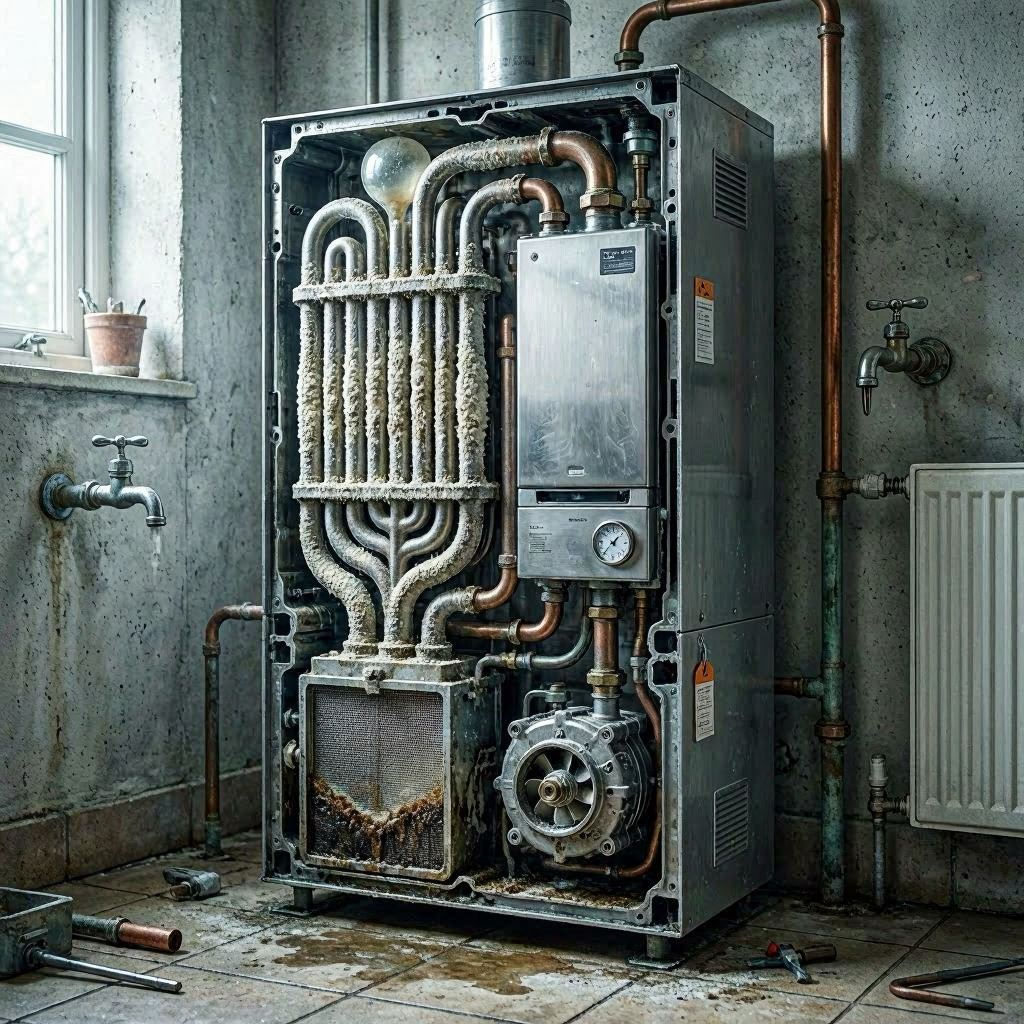
Inside the heart of your appliance sits the primary heat exchanger. This component transfers raw heat energy from the gas flames directly into the water that circulates around your home.
Over years of constant service, two distinct forms of debris settle on the flat metal plates inside this heat cell:
- Limescale: Calcium and magnesium minerals naturally found in hard tap water bake onto the hot surfaces, forming a rock-hard, chalky white crust.
- Magnetite Sludge: Black iron oxide rust breaks away from the inside of your steel radiators and travels back to settle into the low points of the boiler.
Together, this debris creates a dense, irregular insulating blanket over the water channels.
2. The Flash-Boiling Cycle
When your heating turns on, the burner fires at maximum intensity. However, because the metal plates are coated in thick scale or sludge, the thermal energy cannot pass smoothly into the flowing water volume.
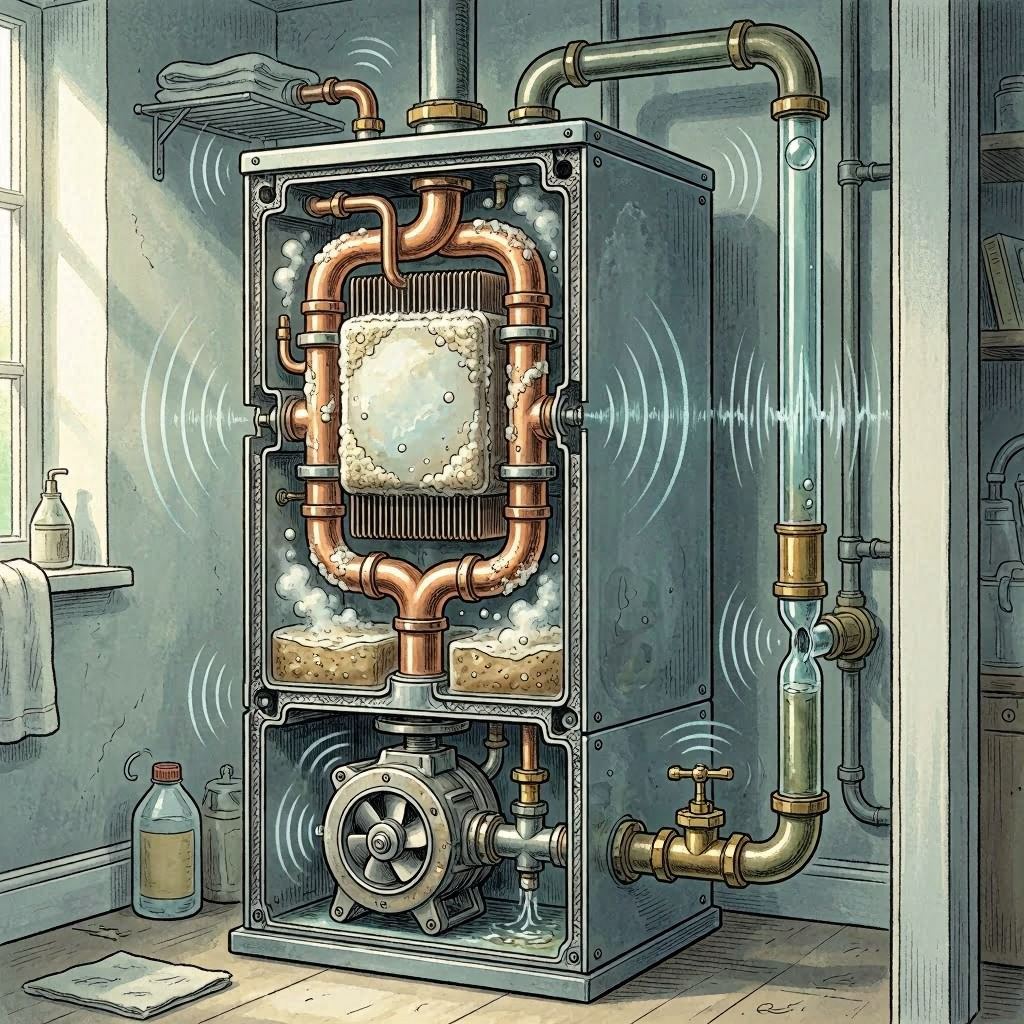
The water trapped directly underneath or inside this layer of sludge instantly shoots past its safe operational threshold and flashes into localized steam bubbles. As these micro-pockets of steam expand rapidly, they break out of the sludge barrier and hit the slightly cooler, moving system water above them.
The moment the steam hits the cooler water, it instantly collapses and implodes. This rapid, violent implosion of millions of microscopic steam bubbles creates a massive kinetic shockwave. It is this continuous acoustic hammering inside the metal housing that you hear through your walls as a loud kettling sound.
Secondary Triggers of Heating System Kettling
While internal component contamination accounts for roughly 80% of all kettling complaints, mechanical and electrical delivery failures can produce identical sound profiles.
The Flow Velocity Problem: If water moves too slowly across the heat cell, it absorbs too much heat per second, driving the system into an immediate flash-boil. This can happen if your central heating circulation pump is seizing up, or if its speed is calibrated too low for the structural layout of your property.
- Faulty Overheat Thermostats (NTC Sensors): If your boiler’s temperature sensors slip out of calibration, they may fail to tell the control board to modulate the gas flame down as the water gets hot. The burner continues to run at 100% capacity when it should be idling, boiling the internal water lines.
- Low System Water Pressure: Water boils at lower temperatures when it is under lower pressure. If your physical bar gauge drops below 0.5 bar, the water inside your system can flash into steam much quicker than it would under standard operating pressures (1.2 to 1.5 bar).
Technical Diagnostic Matrix: Categorizing Boiler Noises
an electrical replacement, or a baseline hydraulic balance, review the symptom matrix below:
| Auditory Pattern | Exact Timing of Sound | System Variable | Likely Root Failure |
| Whistling that shifts into a rhythmic, metallic thumping. | Occurs within 60 to 90 seconds of the gas burner lighting up. | System pressure reads normal (1.2 bar). | Hardened limescale or heavy sludge crusting the primary heat exchanger. |
| Sharp, sudden popping sounds followed by a complete flame shutdown. | Runs loudly for a brief moment before an error code flashes. | Casing underneath feels intensely hot to the touch. | Failing circulation pump or closed internal manual bypass valve. |
| Constant, low-frequency buzzing and bubbling. | Kicks on instantly but gets quieter when you bleed your radiators. | Pressure gauge drops continuously over 24 hours. | Severe air locks or system cavitation due to low water volume. |
How to Fix a Boiler Kettling Sound: Step-by-Step
Resolving a kettling issue involves clearing the internal thermal restrictions and restoring proper fluid velocity across your system.
The Method
1.Re-Pressurize the Water Loop:Pressure Stabilization.
Locate the external filling loop underneath your boiler casing. Open the two small black taps slowly until fresh mains water fills the system. Watch the physical dial rise until the needle sits comfortably between 1.0 and 1.5 bar. Run the system to see if increasing the water density dampens the flash-boiling effect.
2.Optimize Thermostatic Flow Balancing:Gas Regulation.
Walk through every room and ensure your thermostatic radiator valves (TRVs) are turned wide open to maximum settings. If too many individual room radiators are turned off, it creates severe hydraulic resistance, slowing down the return velocity of the water and forcing the boiler to boil its own small internal reserve.
3.Introduce a Heavy-Duty Central Heating Silencer:Chemical De-Scaling.
For mild scaling cases, use a universal central heating injector tool to pump a bottle of specialized Chemical Boiler Silencer directly into a radiator bleed valve. This chemical blend lowers the surface tension of the water and softens the outer edges of the internal limescale crust, reducing steam bubble generation.
When Professional Boiler Repair is Mandatory
If basic pressure adjustments and chemical silencers fail to quiet down your system, you are dealing with advanced, hardened iron oxide blockages that require structural intervention.
+--------------------------------------------------------------+
|               HIGH-VOLUME CHEMICAL POWER FLUSH               |
|                                                              |
| [Power Flush Machine] ---> [Inlet Valve] ---> [Boiler Core]  |
|         ^                                           |        |
|         |-------- [Sludge / Scale Dislodged] <------|        |
+--------------------------------------------------------------+
When it comes to advanced mechanical issues, repairing a boiler that is suffering from structural kettling requires a professional engineer to perform a comprehensive Chemical Power Flush. The technician attaches a high-velocity, high-pressure pumping rig directly to your central heating loop. They circulate heavy-duty organic acids through the heat exchanger while applying magnetic filtration to rip the compacted rust and calcified scale out of the internal waterways.
Attempting to open the sealed combustion chamber yourself to scrub internal components or messing with high-pressure gas valve inputs without certified qualifications poses a major safety risk. Professional intervention ensures the internal seals remain sound and your primary circuit board is protected from expensive accidental water damage.
A boiler kettling sound is a direct physical indicator that your primary heat exchanger is starving for smooth, clean heat transfer. Whether the root cause is a heavy insulating blanket of iron oxide sludge, a rock-hard layer of hard-water limescale, low internal loop pressure, or an over-strained circulation pump, identifying the exact timing of the noise will lead you to the bottleneck. Correct your system pressure first, open up your radiator valves to maintain proper loop velocity, and don’t hesitate to bring in a qualified engineer to flush your system clean before thermal expansion stresses crack your heat cell entirely.