You are sitting in your living room, enjoying a quiet evening, when a strange, aggressive sound starts echoing from the pipes. It sounds exactly like an old-fashioned metal tea kettle left forgotten on a screaming hot stove—a low rumble that builds into a violent whistling, banging, and bubbling.
In the heating trade, we don’t call this a ghost; we call it kettling.
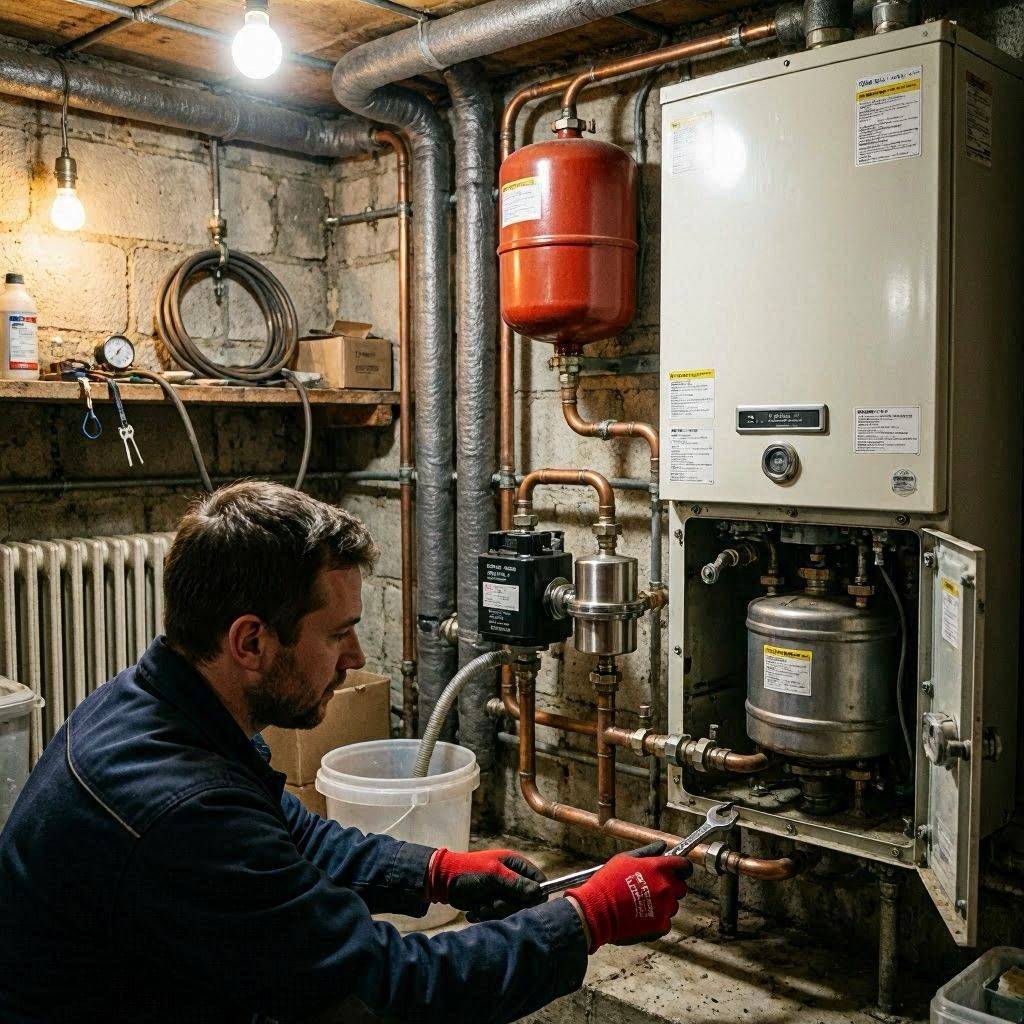
When a heating system starts sounding like an angry locomotive, it’s not just a minor acoustic annoyance. It is a desperate distress signal from the heart of your heating system. Ignoring it is a fast track to a total system shutdown, leaving you stranded in a freezing house, scrambling to find someone capable of repairing a boiler on short notice.
Let’s pull back the metal casing, look at what is actually causing this violent noise, and map out the exact steps required to silence your boiler and restore peace to your home.
What on Earth is “Kettling”?
To understand the noise, you have to understand the basic physics inside your heating system. Your boiler contains a component called a heat exchanger. Think of it as a labyrinth of narrow metal pipes surrounded by intense gas flames. Cold water pumps through these narrow passages, absorbs the heat from the flames instantly, and rushes out toward your radiators.
Kettling happens when the water inside that heat exchanger is restricted. Instead of flowing smoothly, the water becomes trapped or slows down to a crawl.
Because the water is sitting still over a raging flame, it reaches its boiling point and flashes into steam. Those violent bubbles of steam instantly collapse when they hit cooler water further up the pipe. That rapid creation and violent collapse of steam bubbles inside a tight metal chamber is the exact mechanical cause of the banging, whistling, kettling noise.
The 3 Main Culprits Behind the Noise
Boilers don’t just start boiling water internally for no reason. If your system is kettling, it almost always boils down to one of three systemic failures.
1. The Silent Killer: Limescale and Magnetite Sludge
If you live in a hard water area, your water is packed with dissolved minerals like calcium and magnesium. Every time your boiler heats water, a tiny amount of this mineral content bakes onto the inside of the heat exchanger—exactly like the white crust that forms at the bottom of your kitchen kettle.
Furthermore, the inside of your iron radiators slowly corrodes over time, creating a black, muddy sludge called magnetite. This sludge settles in the narrowest part of the system: the heat exchanger. This layer of crust acts as an insulator. The boiler has to burn twice as hot to get heat through the sludge into the water, trapping heat and causing the water to boil instantly.
2. A Dying Circulator Pump
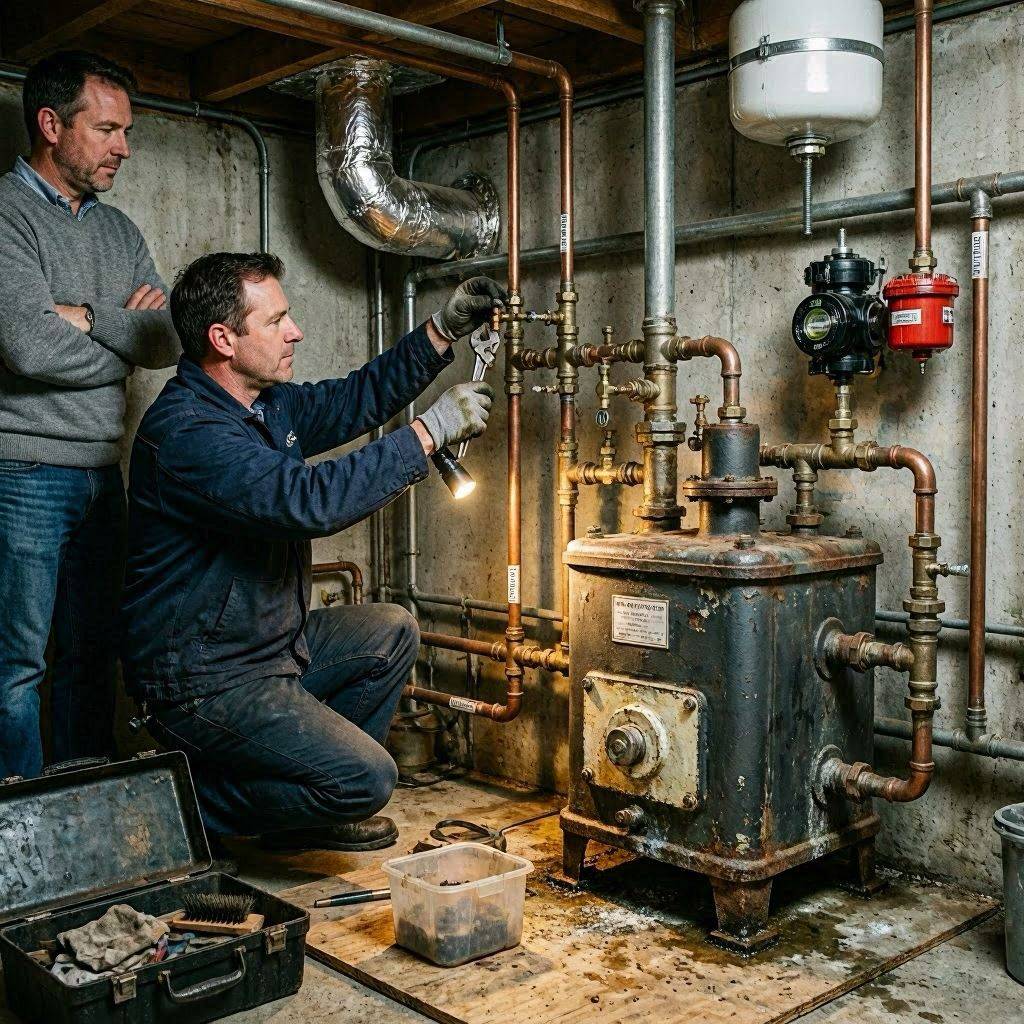
The water in your heating system doesn’t move on its own; it relies on an electric circulator pump to push it along. If the pump’s internal bearings are worn out, if the speed setting is too low, or if the pump has seized entirely, the water stops moving. Stagnant water over a hot flame equals instant steam, resulting in loud kettling noises.
3. Incorrect Gas Burner Settings (Over-Firing)
Sometimes, the issue isn’t the water at all; it’s the fire. If the gas valve on your boiler was set incorrectly during installation or a previous service, it might be delivering too much gas to the burner. This “over-firing” creates an intense heat that the water cannot absorb fast enough, leading to localized boiling.
The Blueprint for Repairing a Boiler with a Kettling Issue
When it comes to repairing a boiler that has turned into a screaming kettle, the solution depends entirely on how long the problem has been brewing. Here is a breakdown of the troubleshooting hierarchy, from simple fixes to advanced mechanical overhauls.
[Kettling Detected]
       │
       ├──► Step 1: Check System Pressure (DIY)
       │
       ├──► Step 2: Add Chemical De-Scaler/Silencer (Intermediate DIY)
       │
       └──► Step 3: Professional Power Flush & Component Replacement (Expert Needed)
Step 1: The Zero-Cost Pressure Check
Before panic-buying parts, look at the pressure gauge on the front of your boiler. If the pressure has dropped below 1.0 bar, there isn’t enough water volume or pressure to keep the system stable. Low pressure allows water to vaporize into steam at a much lower temperature. If it’s low, use your filling loop to top the pressure back up to 1.5 bar and see if the noise subsides.
Step 2: Chemical Flushing (The Intermediate Fix)
If the noise is a recent development and isn’t too violent yet, you might be able to dissolve the internal crust yourself.
- You can purchase a specialized central heating system silencer or de-scaler chemical.
- This liquid is injected into the system via a radiator or the filling loop.
- It circulates through the pipes, gently breaking down the limescale and soft sludge over a few days, allowing the water to flow freely again.
Step 3: The Heavy Artillery – A Professional Power Flush
If your boiler sounds like it’s about to blast off into space, chemical additives from a bottle won’t cut it. You have built up years of hardened magnetite and scale.
At this stage, repairing a boiler requires a professional heating engineer equipped with a power flushing machine. They will isolate your boiler, hook up a massive, high-flow external pump, and force heavy-duty chemicals through the heat exchanger at high velocity but low pressure. This physically scours the internal metal clean, dumping gallons of black, metallic mud out of your system and restoring the heat exchanger to factory-level efficiency.
Why You Cannot Afford to Ignore Kettling
Many homeowners assume that as long as the radiators are still getting hot, a noisy boiler is something they can just live with. This is a massive financial mistake.
| The Cost of Delay | The Consequence |
| Soaring Fuel Bills | A scaled-up heat exchanger requires significantly more gas to heat the same amount of water, killing your boiler’s efficiency. |
| Cracked Heat Exchanger | The extreme temperature stress caused by localized boiling can cause the cast iron or aluminum heat exchanger to crack. If this happens, the boiler is effectively dead. |
| Pump Destruction | Forcing a pump to struggle against a wall of sludge will burn out its motor, adding extra replacement parts to your repair bill. |
Keep the Flow Moving
A healthy boiler should be felt, not heard. If your system has started kettling, don’t wait for the inevitable mid-winter breakdown. What starts as a minor scale buildup can quickly escalate into a catastrophic structural failure of the heat exchanger.
Take action early. Bleed your radiators, check your system pressure, and if the mechanical rumble persists, call in a reputable heating professional. Investing a little time and money into repairing a boiler’s internal flow today will save you thousands in premature replacement costs tomorrow. Keep the water moving, keep the scale out, and keep your home peacefully quiet.